
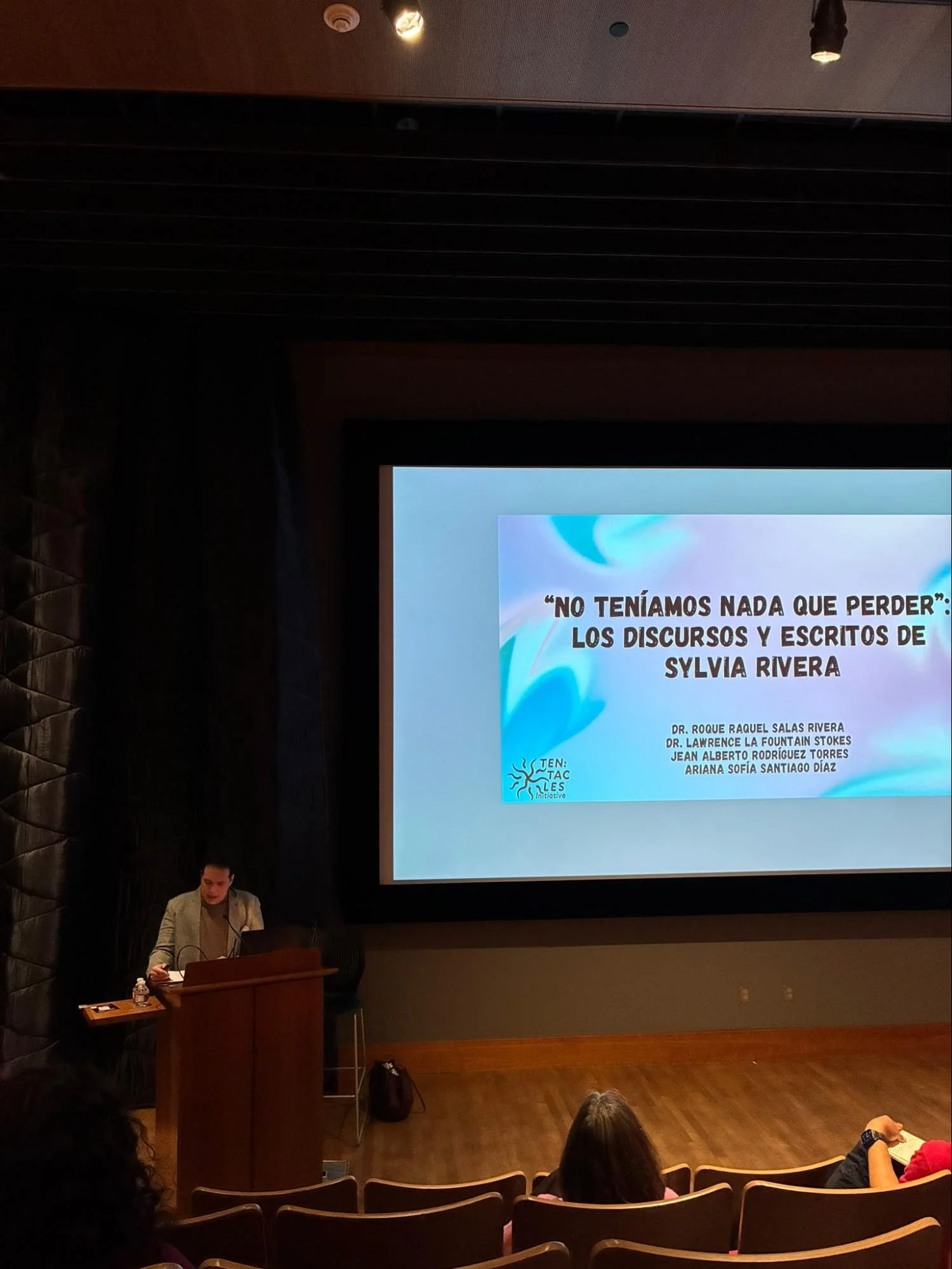
As part of the Francisco Scarano Series of the Puerto Rican Studies Hub at the University of Wisconsin–Madison, Roque Raquel Salas-Rivera presented “Como Anguila: Eel Translations and the Colonial Embodiments of Language,” a work-in-progress that traces the translations that have irreversibly marked Puerto Rican history. Salas-Rivera offered a decolonial approach to translation that challenges the assumption that language can move seamlessly between worlds without carrying the weight of colonial histories, power relations, and embodied experiences. The title itself invites us to consider the eel as a figure for movement and elusiveness. Inspired by Fray Ramón Pané’s account of Taíno cosmology, Salas-Rivera draws attention to the slippery movements through which we might escape a colonial grasp. Like an eel, language refuses to remain still; it moves across borders and evades the categories imposed upon it. This metaphor becomes particularly meaningful when we think of Puerto Rico, where language is inseparable from the island’s colonial history and from the everyday negotiations.
One of the most compelling aspects of the talk was Salas-Rivera’s consideration of linguistic refusal: the possibility that refusing to translate can itself become a political and decolonial gesture. Translation is often understood as an act of accessibility: a bridge between languages and communities. Yet, as Salas-Rivera’s work suggests, translation can also become a form of assimilation when it demands that certain experiences and ways of knowing be made legible within the dominant language. Who is expected to translate, and why do we so often assume that speaking a language makes someone responsible for translating it for others? This question challenges the unequal distribution of linguistic labor and the expectation that marginalized speakers must continually make themselves understandable to those in positions of power. Salas Rivera’s reflections also invite us to question who gets to determine what counts as proper language. Puerto Rican way of speech is frequently subjected to linguistic policing, with its particular expressions and combinations dismissed as incorrect or defective. Drawing on Yásnaya Aguilar-Gil was especially significant in this regard, as her work invites us to understand language as a political terrain shaped by state power and the marginalization of Indigenous languages. Her interventions are particularly relevant to Salas-Rivera’s discussion because they challenge the assumption that linguistic legitimacy depends on proximity to dominant languages or standardized forms of speech. Read alongside Aguilar-Gil, “Como Anguila” encourages us to consider not only what gets lost in translation, but also whose language is expected to accommodate whom, and whose ways of knowing are rendered illegible in the process.
Through a poetic and politically conscious engagement with language, Salas-Rivera demonstrated that translation is never simply a matter of transferring meaning from one language to another. Sometimes, decolonial practice requires translation; at other times, it requires allowing words to remain untranslated, resisting the demand that everything become immediately legible. Like the eel, language can slip away from the colonial categories that attempt to contain it, reminding us that not everything must be captured, explained, or made to fit within the terms of the dominant world.